About
Background:
Advanced functional materials used in aerospace, energy, and biomedical applications are typically composed of advanced metallic and composite systems. However, these structures face significant technical challenges when subjected to extreme environments such as impact loading, thermal extremes, and corrosive conditions. Enhancing the resistance of these materials under such conditions is essential for improving the safety, reliability, and longevity of engineered systems.
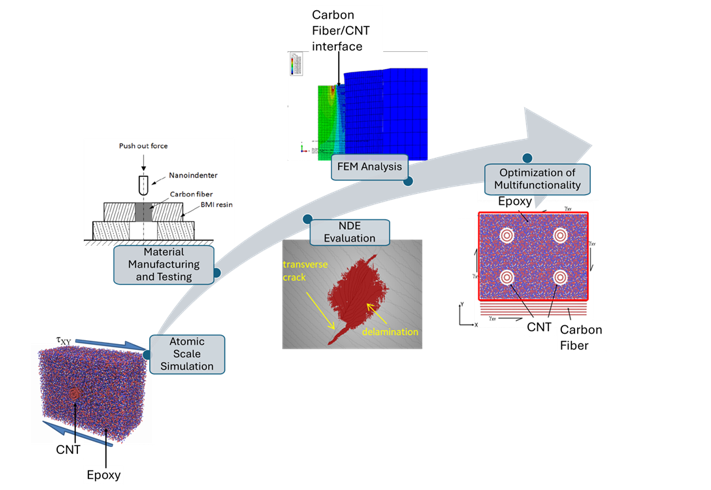
This research integrates cutting-edge materials science, multiscale computational mechanics, and rigorous experimental validation through advanced non-destructive evaluation (NDE) techniques. This integrated framework enables the intentional design and engineering of multifunctional structural materials with improved long-term resilience and sustainability.
The work builds upon established expertise in multiscale modeling and material characterization, with a particular focus on polymeric systems. The fundamental principles governing material behavior under extreme conditions are broadly applicable across aerospace and automotive engineering domains, as well as emerging areas such as in-space manufacturing.
Approach:
Our approach to tackle these challenges spans across multiple length and time scales.
Nnanoscale Study: Employoing Molecular Dynamics based simulations to explore how nanoscale inclusions/reinforcements, such as carbon nanotubes and graphene nanoparticles, we aim to enhance the mechanical and thermal properties of polymer matrices and enhance the multifunctional properties of such advanced materials. We intend to develop an integrated MD-based computational framework that predicts and optimizes the bulk properties of nanofilled polymers by capturing critical atomic-level phenomena, including interfacial mechanics, dispersion quality, and volume fraction effects. The outcomes of this work will reveal key mechanisms at the nanoscale that directly affect macroscale material behavior and performance.
Macroscale Validations: Building upon the nanoscale information we intend to characterize damage mechanisms and degradation processes in advanced composite systems subjected to extreme conditions such as impact damage and lightning-induced thermal degradation. This research is instrumental in developing robust frameworks for predictive structural health monitoring and damage mitigation strategies, enabling enhanced structural safety and longevity. By utilizing non-destructive evaluation (NDE) infrastructure—including phased array ultrasonic testing (PAUT) and X-ray computed tomography (XCT)—to validate mesoscale damage models for advanced composites, we intend to get a deeper understanding of the macroscale mechanisms in these advanced materials.